UNIVERSE-A MYSTERY THAT HASN'T SOLVED YET
All u know about space like stars,planets,our milky-way galaxy,comets and what and everything u see in either news,science channels and other sources.But there is a great mystery that ever have been solved by us in the UNIVERSE.
Here i can tell u about the unbelievable things of the UNIVERSE
Here i can tell u about the unbelievable things of the UNIVERSE
Loading
The Secrets of the Universe

TIME LINE OF THE UNIVERSE
There was a time when people believed that the stars were bonfires lit by
other tribes in the sky, that the universe was a flat plate resting on the shell of a giant turtle, and that the Earth, according to the Greek astronomer Ptolemy, was at the center of the universe. From the most remote of times, people have been curious about what lies hidden beyond the celestial sphere. This curiosity has led them to build telescopes that show with clarity otherwise blurry and distant objects. In this site you will find the history of the cosmos illustrated with spectacular images that show in detail how the cosmos was formed, the nature of the many points of light that adorn the night sky, and what lies ahead. You will also discover how the suns that inhabit space live and die, what dark matter and black holes are, and what our place is in this vastness. Certainly, the opportunity to compare the destiny of other worlds similar to ours will help us understand that for the time being there is no better place than the Earth to live. At least for now.
In the Milky Way—according to mathematical and physical calculations—there are more than 100 billion stars, and such a multitude leads to the Question: Is it possible that our Sun is the only star that possesses an inhabited planet?
Astronomers are more convinced than ever of the possibility of life in other worlds. We just need to find them. Reading this will let you become better acquainted with our neighbors in the solar system—the other planets—and the most important characteristics that distinguish them. All this information that explores the mysteries of space is accompanied by recent images captured by the newest telescopes. They reveal many details about the planets and their satellites, such as the volcanoes and craters found on the surface of some of them. You will also learn more about the asteroids and comets that orbit the Sun and about Pluto, a dwarf planet, which is to be visited by a space probe for the first time. Less than a decade ago, astronomers began observing frozen worlds, much smaller than a planet, in a region of the solar system called the Kuiper belt. We invite you to explore all of this. The images and illustrations that accompany the text will prove very helpful in studying and understanding the structure of all the visible and invisible objects (such as dark matter) that form part of the universe. There are stellar maps showing the constellations, the groups of stars that since ancient times have served as a guide for navigation and for the development of calendars. There is also a review through history: from Ptolemy, who thought the planets orbited around the Earth, and Copernicus, who put the Sun in the center, and Galileo, the first to aim a telescope skyward, up to the most recent astronomical theories, such as those of Stephen Hawking, the genius of space and time who continues to amaze with his discoveries about the greatest mysteries of the cosmos. You will find these and many more topics no matter where you look in this
fantastic site that puts the universe and its secrets in your hands.
other tribes in the sky, that the universe was a flat plate resting on the shell of a giant turtle, and that the Earth, according to the Greek astronomer Ptolemy, was at the center of the universe. From the most remote of times, people have been curious about what lies hidden beyond the celestial sphere. This curiosity has led them to build telescopes that show with clarity otherwise blurry and distant objects. In this site you will find the history of the cosmos illustrated with spectacular images that show in detail how the cosmos was formed, the nature of the many points of light that adorn the night sky, and what lies ahead. You will also discover how the suns that inhabit space live and die, what dark matter and black holes are, and what our place is in this vastness. Certainly, the opportunity to compare the destiny of other worlds similar to ours will help us understand that for the time being there is no better place than the Earth to live. At least for now.
In the Milky Way—according to mathematical and physical calculations—there are more than 100 billion stars, and such a multitude leads to the Question: Is it possible that our Sun is the only star that possesses an inhabited planet?
Astronomers are more convinced than ever of the possibility of life in other worlds. We just need to find them. Reading this will let you become better acquainted with our neighbors in the solar system—the other planets—and the most important characteristics that distinguish them. All this information that explores the mysteries of space is accompanied by recent images captured by the newest telescopes. They reveal many details about the planets and their satellites, such as the volcanoes and craters found on the surface of some of them. You will also learn more about the asteroids and comets that orbit the Sun and about Pluto, a dwarf planet, which is to be visited by a space probe for the first time. Less than a decade ago, astronomers began observing frozen worlds, much smaller than a planet, in a region of the solar system called the Kuiper belt. We invite you to explore all of this. The images and illustrations that accompany the text will prove very helpful in studying and understanding the structure of all the visible and invisible objects (such as dark matter) that form part of the universe. There are stellar maps showing the constellations, the groups of stars that since ancient times have served as a guide for navigation and for the development of calendars. There is also a review through history: from Ptolemy, who thought the planets orbited around the Earth, and Copernicus, who put the Sun in the center, and Galileo, the first to aim a telescope skyward, up to the most recent astronomical theories, such as those of Stephen Hawking, the genius of space and time who continues to amaze with his discoveries about the greatest mysteries of the cosmos. You will find these and many more topics no matter where you look in this
fantastic site that puts the universe and its secrets in your hands.
What Is the Universe?
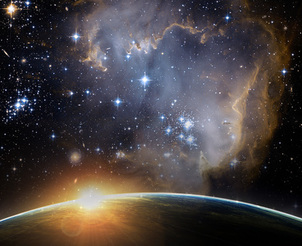
The universe is everything that exists, from the smallest particles to the largest ones, together with all matter and energy. The universe includes visible and invisible things, such as dark matter, the great, secret component of the cosmos. The search for dark matter is currently one of the most important tasks of cosmology. Dark matter may literally determine the density of all of space, as well as decide the destiny of the universe. Did you know that, second by second, the universe grows and grows? The question that astronomers are asking—the question that concerns them the most—is how much longer the universe can continue to expand like a
balloon before turning into something cold and dark.
The universe, marvelous in its majesty, is an ensemble of a hundred billion galaxies. Each of these galaxies (which tend to be found in large groups) has billions of stars. These galactic concentrations surround empty spaces, called cosmic voids. The immensity of the cosmos can be better grasped by realizing that the size of our fragile planet Earth, or even that of the Milky Way, is insignificant compared to the size of the remainder of the cosmos.
balloon before turning into something cold and dark.
The universe, marvelous in its majesty, is an ensemble of a hundred billion galaxies. Each of these galaxies (which tend to be found in large groups) has billions of stars. These galactic concentrations surround empty spaces, called cosmic voids. The immensity of the cosmos can be better grasped by realizing that the size of our fragile planet Earth, or even that of the Milky Way, is insignificant compared to the size of the remainder of the cosmos.
Dark matter
The visible objects in the cosmos represent only a small fraction of the total matter within the universe. Most of it is invisible even to the most powerful telescopes. Galaxies and their stars move as they do because of the gravitational forces exerted by this material, which astronomers call dark matter.
|
Evolution of matter
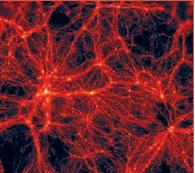
What can be observed in the universe today is a great quantity of matter grouped into galaxies. But that was not the original form of the universe. What the big bang initially produced was a cloud of uniformly dispersed gas. Just three million years later, the gas began to organize itself into filaments. Today the universe can be seen as a network of galactic filaments with enormous voids between them.
9.1 billion years-THE EARTH IS CREATED Like the rest of the planets, the Earth is made of material that remained after the formation of the solar system. The Earth is the only planet known to have life. |
Everything Comes to an End
The big bang theory helped solve the enigma of the early moments of the universe. What has yet to be resolved is the mystery surrounding the future that awaits. To unravel this mystery, the total mass of the universe must be known, but that figure has not yet been reliably determined. The
most recent observations have removed some of this uncertainty. It seems that the mass of the universe is far too little to stop its expansion. If this is this case, the universe's present growth is merely the last step before its total death in complete darkness.
1.Flat Universe
There is a critical amount of mass for which the universe would expand at a declining rate without ever totally stopping. The result of this eternal expansion would be the existence of an ever-increasing number of galaxies and stars. If the universe were flat, we could talk about a cosmos born from an explosion, but it would be a universe continuing outward forever. It is difficult to think about a universe with these characteristics.
2.Closed Universe
If the universe had more than critical mass, it would expand until reaching a point where gravity stopped the expansion. Then, the universe would contract in the Big Crunch, a total collapse culminating in an infinitely small, dense, and hot spot similar to the one from which the universe was formed. Gravity's pull on the universe's excess matter would stop the expansion and reverse the process.
3.Self-generated Universes
A less widely accepted theory about the nature of the universe suggests that universes generate themselves. If this is the case, universes would be
created continuously like the branches of a tree, and they might be linked by super massive black holes.
4.Open Universe
The most accepted theory about the future of the cosmos says that the universe possesses a mass smaller than the critical value. The latest measurements seem to indicate that the present time is just a phase before the death of the universe, in which it goes completely dark.
For more understanding of this click here
most recent observations have removed some of this uncertainty. It seems that the mass of the universe is far too little to stop its expansion. If this is this case, the universe's present growth is merely the last step before its total death in complete darkness.
1.Flat Universe
There is a critical amount of mass for which the universe would expand at a declining rate without ever totally stopping. The result of this eternal expansion would be the existence of an ever-increasing number of galaxies and stars. If the universe were flat, we could talk about a cosmos born from an explosion, but it would be a universe continuing outward forever. It is difficult to think about a universe with these characteristics.
2.Closed Universe
If the universe had more than critical mass, it would expand until reaching a point where gravity stopped the expansion. Then, the universe would contract in the Big Crunch, a total collapse culminating in an infinitely small, dense, and hot spot similar to the one from which the universe was formed. Gravity's pull on the universe's excess matter would stop the expansion and reverse the process.
3.Self-generated Universes
A less widely accepted theory about the nature of the universe suggests that universes generate themselves. If this is the case, universes would be
created continuously like the branches of a tree, and they might be linked by super massive black holes.
4.Open Universe
The most accepted theory about the future of the cosmos says that the universe possesses a mass smaller than the critical value. The latest measurements seem to indicate that the present time is just a phase before the death of the universe, in which it goes completely dark.
For more understanding of this click here
What Is in the Universe?
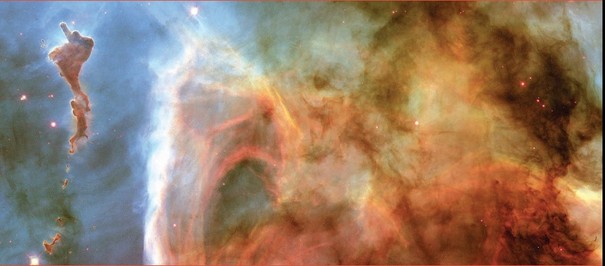
The universe is populated on a grand scale by strands of super clusters surrounding vacant areas. Sometimes the galaxies collide with each other, triggering the formation of stars. In the vast cosmos, there are also quasars, pulsars, and black holes. Thanks to current technology, we can enjoy the displays of light and shadow that make up, for example, the Eta Carinae Nebula (shown), which is composed of jets of hot, fluorescent gases. Although not all the objects in the universe are known, it can be said without a doubt that most of the atoms that make up our bodies have been born in the interior of stars.
Luminous
For a long time stars were a mystery to humans, and it was only as recently as the 19th century that astronomers began to understand the true nature of stars. Today we know that they are gigantic spheres of incandescent gas—mostly hydrogen, with a smaller proportion of helium. As a star radiates light, astronomers can precisely measure its brightness, color, and temperature.
Because of their enormous distance from the Earth, stars beyond the Sun only appear as points of light, and even the most powerful telescopes do not reveal any surface features. |
Stellar Evolution
Stars are born in nebulae, which are giant clouds of gas (mainly hydrogen) and dust that float in space. Stars can have a life span of millions, or even billions, of years. The biggest stars have the shortest lives, because they consume their nuclear fuel (hydrogen) at a very accelerated rate. Other stars, like the Sun, burn fuel at a slower rate and
may live some 10 billion years. Many times, a star's size indicates its age. Smaller stars are the youngest, and bigger stars are approaching their end, either through cooling or by exploding as a supernova. For more about stars click here |
Red, Danger, and Death
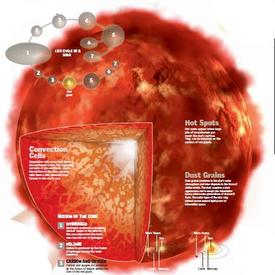
When a star exhausts its hydrogen, it begins to die. The helium that now makes up the star's core begins to undergo nuclear reactions, and the star remains bright. When the star's helium is depleted, fusion of
carbon and oxygen begins, which causes the star's core to contract. The star continues to live, though its surface layers begin to expand and cool as the star turns into a red giant. Stars similar to the Sun (solar-type stars) follow this process. After billions of years, they end up as white dwarfs. When they are fully extinguished, they will be black dwarfs, invisible in space. |
Gas Shells
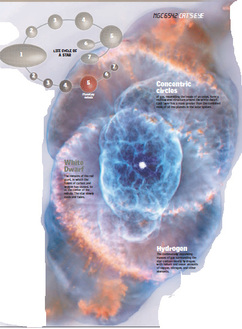
When a small star dies, all that remains is an expanding gas shell known as a planetary nebula, which has nothing to do with the planets. In general, planetary nebulae are symmetrical or spherical objects. Although it has not been possible to determine why they exist in such diversity, the reason may be related to the effects of the magnetic field of the dying central star. Viewed through a telescope, several nebulae can be seen to contain a central dwarf star, a mere remnant of its precursor star
|
The Final Darkness
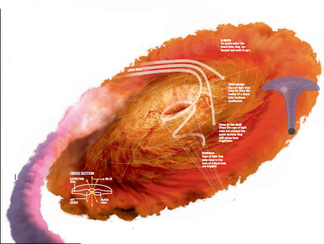
The last stage in the evolution of a star's core is its transformation into a very dense, compact stellar body. Its particulars depend upon the amount of mass involved in its collapse. The largest stars become black holes, their density so great that their gravitational forces capture even light. The only way to detect these dead stars is by searching for the effects of their gravitation
Black Hole The objects that approach the black hole too closely are swallowed by it. The black hole's gravitational well is infinite and traps matter and light forever. The event horizon describes the limit of what is, and is not, absorbed. Any object that crosses the event horizon follows a spiral path into the gravitational well. Some scientists believe in the existence of so called wormholes—anti gravity tunnels, through which travel across the universe is hypothesized to be possible. By taking advantage of the curvature of space, scientists think it could be possible to travel from the Earth to the Moon in a matter of seconds. |
Discovery of Black Holes
The only way of detecting the presence of a black hole in space is by its effect on neighboring stars. Since the gravitational force exerted by a black hole is so powerful, the gases of nearby stars are absorbed at great speed, spiraling toward the black hole and forming a structure called an accretion disk. The friction of the gases heats them until they shine brightly. The hottest parts of the accretion disk may reach 100,000,000° C and are a source of X-rays. The black hole, by exerting such powerful gravitational force, attracts everything that passes close to it, letting nothing escape. Since even light is not exempt from this phenomenon, black holes are opaque and invisible to even the most advanced telescopes. Some astronomers believe that super massive black holes might have a mass of millions, or even billions, of solar masses.
Neutron Star When a star's initial mass is between 10 and 20 solar masses, its final mass will be larger than the mass of the Sun. Despite losing great quantities of matter during nuclear reactions, the star finishes with a very dense core. Because of its intense magnetic and gravitational fields, a neutron star can end up as a pulsar. A pulsar is a rapidly spinning neutron star that gives off a beam of radio waves or other radiation. As the beam sweeps around the object, the radiation is observed in very regular pulses. |
Anatomy of Galaxies
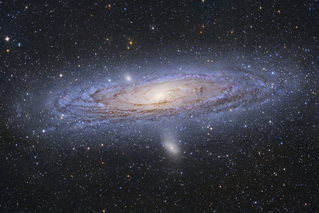
Galaxies are rotating groups of stars, gas, and dust. More than 200 years ago, philosopher Immanuel Kant postulated that nebulae were island-universes of distant stars. Even though astronomers now know that galaxies are held together by gravitational force, they have not been able to decipher what reasons might be behind galaxies' many shapes. The various types of galaxies range from ovals of old stars to spirals with arms of young stars and bright gases. The center of a galaxy has the greatest accumulation of stars. The Milky Way Galaxy is now known to be so big that rays of light, which travel at 186,000 miles (300,000 km) per second, take 100,000 years to cross from one end to the other.
MILKY WAY
Seen from its side, the Milky Way looks like a flattened disk, swollen at the center. Around
the disk is a spherical region, called a halo, containing dark matter and globular clusters of stars. From June to September, the Milky Way is especially bright, something that would make it more visible viewed from above than from the side.
MILKY WAY
Seen from its side, the Milky Way looks like a flattened disk, swollen at the center. Around
the disk is a spherical region, called a halo, containing dark matter and globular clusters of stars. From June to September, the Milky Way is especially bright, something that would make it more visible viewed from above than from the side.